The story of Mohamed, Enforcement and Monitoring Officer
‘Sometimes I issue a fine, but I prefer helping organisations find the right solution’ Tell your friends you work for the government and their reactions speak volumes: open-plan offices,…

Everyone has an opinion about asylum. But on the work floor, making the right assessment is all that matters.
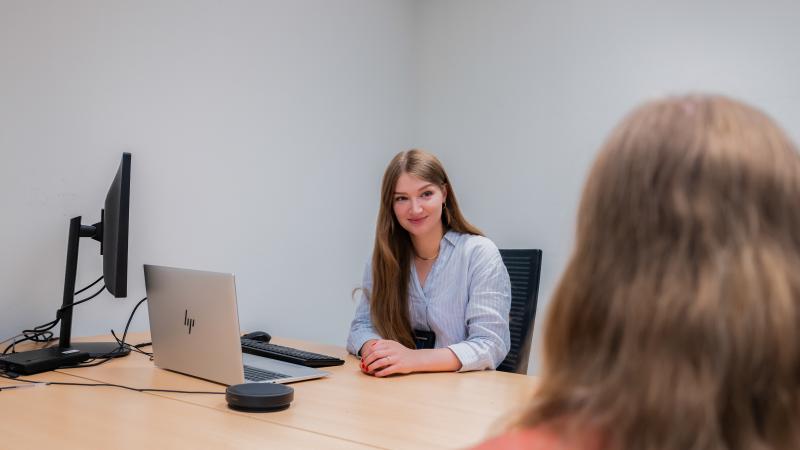
An interview and decision officer at the Immigration and Naturalisation Service (IND) interviews asylum seekers and assesses whether they qualify for a residence permit in the Netherlands. Maninne prepares every interview, asks the questions needed to carefully assess a case, and then makes the decision on the application herself.
‘I have always been interested in politics and political issues,’ says Maninne. ‘But over time, I realised that I find frontline work even more interesting than policy. I came across this vacancy while I was finishing my degree in American Studies, and it stood out straight away. Asylum and migration are key issues in the public debate, and I was simply curious: what is it really like? What happens behind the scenes?’
Her lack of a legal background proved no obstacle to a career at the IND. ‘I have colleagues who studied law, but also colleagues with degrees in cultural anthropology or languages. If you have the motivation and the required level of analytical ability, anyone can be a good fit for this role. Of course, I could not simply start straight away. First, I had a year of internal training, in which I learned all about the legislation, the assessment framework and conducting interviews. Only then could I start working independently.’
When asked what she likes most about her job, Mannine does not hesitate a second: ‘Solving puzzles. I look at a case file and search for the information I need. Sometimes, certain elements of an applicant’s story do not add up, like a detail that does not match the account of the person’s flight, or a statement that seems contradictory. In that case, it is up to me to find out what happened. The investigative work is incredibly interesting.’
Maninne’s work is split evenly across conducting interviews and making decisions. ‘When I have an interview, I prepare for it first: what is already in the case file, what do I not yet understand, what else do I need? And then I listen very carefully to what the applicant tells me. Why did they have to leave their country of origin? After listening to their account, I ask targeted questions and gather all the information I need to make the right decision.’
Some interviews leave a lasting impression. Such as the interview with someone who had fled because of their sexual orientation. ‘That person came from an environment where they simply could not be themselves,’ says Maninne. ‘During the interview, I could see the tension this caused. The first thing I did was try to put them at ease by breaking the ice with a joke, by listening carefully and making space for their emotions. I felt proud when I saw them visibly relax. It was a wonderful and, above all, deeply rewarding experience.’
Not every application can be granted, however, and Mannine regularly writes refusals, for example when an account raises many questions or when someone is not at risk in their country of origin. ‘That is part of the job. Even when the applicant’s account is distressing, there may be no need for protection. I believe in legal fairness and in the assessment framework we apply. The IND is not there to solve all the world’s problems.’
The IND operates in a politically charged area, but it is not a political organisation. That distinction matters to Maninne. ‘I was curious beforehand about what it would be like,’ she says, ‘but on the work floor, people keep their political leanings to themselves. Everyone has their own opinion: we are all human, after all, and we read the news. But here, it always comes down to one thing: assessing each case on its merits.’
‘Our work affects people’s lives, so we give our time and attention to every case, whether it is granted or not. The IND is not a rubber-stamping machine that simply operates on autopilot.’
Maninne found her first ‘real’ job at the IND. ‘The foundations here are simply good,’ she says happily. ‘I enjoy my work and the employment conditions are good. For instance, I can work from home some of the time, and I have an individual flexible benefits budget, which I can use to pay off my student debt or buy additional annual leave.’
She also feels that careful consideration is given to what employees need to get the best out of themselves. ‘I have only been here two years, but I am already encouraged to take training courses, even when they are outside my direct field of expertise. I appreciate that freedom. It shows that the IND invests in my personal and professional development. So, if someone asked me whether they should apply, I would say: go for it!’
Curious? Visit our Careers page and find the right vacancy for you!
‘Sometimes I issue a fine, but I prefer helping organisations find the right solution’ Tell your friends you work for the government and their reactions speak volumes: open-plan offices,…

‘There’s no standard procedure for some situations’ Should someone be allowed to enter the Netherlands or not? That is the question the Royal…

'The IND is not a rubber-stamping machine' For decades, asylum has been the subject of much debate, writing and discussion. Maninne wanted to…