The story of Mohamed, Enforcement and Monitoring Officer
‘Sometimes I issue a fine, but I prefer helping organisations find the right solution’ Tell your friends you work for the government and their reactions speak volumes: open-plan offices,…

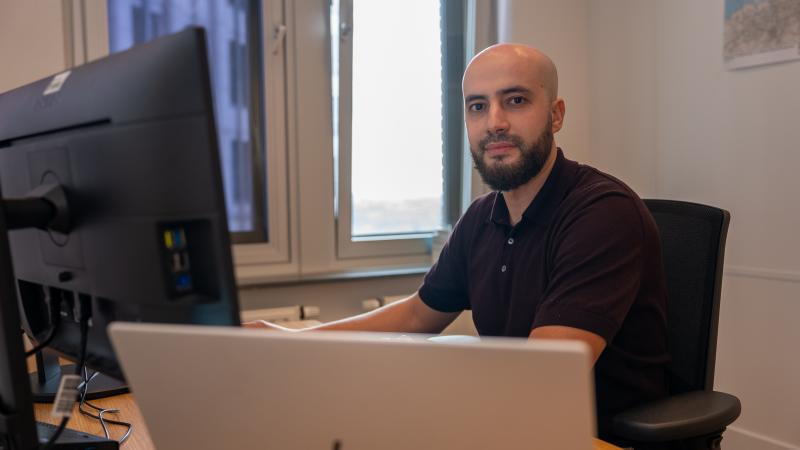
I much prefer working with organisations to make sure the same mistake is not made again.
A recognised sponsor is an organisation that the IND has designated as a reliable partner, for example a large company, an educational institution or an au pair agency. Such organisations may apply for residence permits for people coming to the Netherlands from outside of Europe to work, study or become an au pair.
Sponsor status has benefits: their applications are processed more quickly, and they have to submit fewer supporting documents than organisations without recognised-sponsor status. In return, however, the organisation must follow a fixed set of rules. For example, a recognised sponsor must report in good time when a highly skilled migrant leaves, or if anything changes in their employment contract. Mohamed and his colleagues check that this is actually done.
‘The breach I see most often isn’t as exciting as you might think,’ Mohamed laughs. ‘Organisations often simply forget to deregister someone. A highly skilled migrant leaves their job, or a student drops out. A recognised sponsor must report this, because it affects that person’s right to remain in the Netherlands. So, as the IND, you want to stay on top of that.’
‘My work almost always starts with a report,’ Mohamed explains. ‘For instance, an au pair may feel that their host family or agency didn’t treat them properly. They can report this to us. We also get reports from partner organisations, such as the Netherlands Labour Authority, or from within our own organisation.’
All these reports are brought together in a case file, which is then assigned to Mohamed or one of his colleagues. ‘Then I start investigating. What can I find out about the organisation? Do they have any previous violations? That is the monitoring side of my work. I conclude every investigation with a report of findings; a legal document that is used during a follow-up investigation and gets presented if an organisation appeals to the court. So, I have to record exactly what I have seen and what I base my conclusions on.’
Once the investigation is complete, Mohamed passes the case file to a colleague responsible for enforcement. ‘We deliberately keep these two roles separate. You never enforce against a case you have investigated. But., I do carry out both roles. One day I am a compliance officer, the next I am an enforcement officer. I might have a frank conversation about a breach, issue a warning or impose a fine. And sometimes I withdraw the organisation’s status entirely.’
The work can be daunting, Mohamed admits. ‘We also deal with large international companies where nobody speaks Dutch. Then I try, in my best English, to explain that they are in violation and find out how they will make sure it does not happen again.’
Mohamed much prefers working with an organisation to find the right solution. ‘That is what I enjoy most about my work. What is going wrong in the recognised sponsor’s process, and what could they change? It is really satisfying when I see that the same mistake does not happen again afterwards.’
Sometimes this doesn’t work out. Mohamed recalls an au pair agency that repeatedly made the same mistake. His team intervened several times, through meetings, warnings and fines, but did not achieve the intended result. Eventually, the IND withdrew the agency’s recognised-sponsor status, which meant it was no longer allowed to bring au pairs to the Netherlands. ‘I was involved in those interventions. In the end, the au pairs found agencies that did comply with the rules.’
Although his friends sometimes think otherwise, Mohamed finds his work anything but boring. This also has to do with the organisation itself. ‘The IND is willing to approach things differently. For example, my managers encourage my colleagues and me to come up with ideas for improvement ourselves.’
‘For years, we used to issue fines fairly quickly when a recognised sponsor failed to comply with the rules,’ Mohamed says. ‘But our team noticed that this did not always work best. We preferred an enforcement approach that helps organisations prevent mistakes. We raised this, and for the past year we have been doing things differently. Within the confines of the law, my team therefore decides for itself how we work. After all, those of us on the ground know best what does and does not work. It is good to have that latitude.’
Mohamed’s career also shows that he enjoys working here. ‘I have now been with the IND for six years. I started as an asylum caseworker at Schiphol, worked on family-reunification cases for a while, and have now been in monitoring and enforcement for almost two years. The IND gave me the space to discover more and more what suited me. And wherever you work, there is always a social dimension to the job. That matters to me too.’
‘What people see of the IND is almost always about asylum,’ Mohamed concludes. ‘That makes sense, because that is what makes the news. But I would like to correct that impression. We do far more than that, and we have all kinds of roles. There is something for everyone, I would say. An office job? Not such a bad thing after all.’
Want to know more? Visit our Careers page and find the right vacancy for you!
‘Sometimes I issue a fine, but I prefer helping organisations find the right solution’ Tell your friends you work for the government and their reactions speak volumes: open-plan offices,…
‘There’s no standard procedure for some situations’ Should someone be allowed to enter the Netherlands or not? That is the question the Royal…

'The IND is not a rubber-stamping machine' For decades, asylum has been the subject of much debate, writing and discussion. Maninne wanted to…