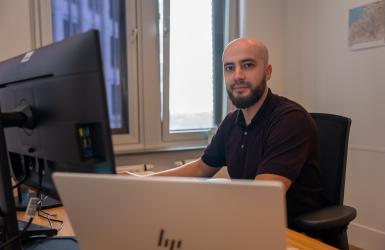
The story of Mohamed, Enforcement and Monitoring Officer
‘Sometimes I issue a fine, but I prefer helping organisations find the right solution’ Tell your friends you work for the government and their reactions speak volumes: open-plan offices,…

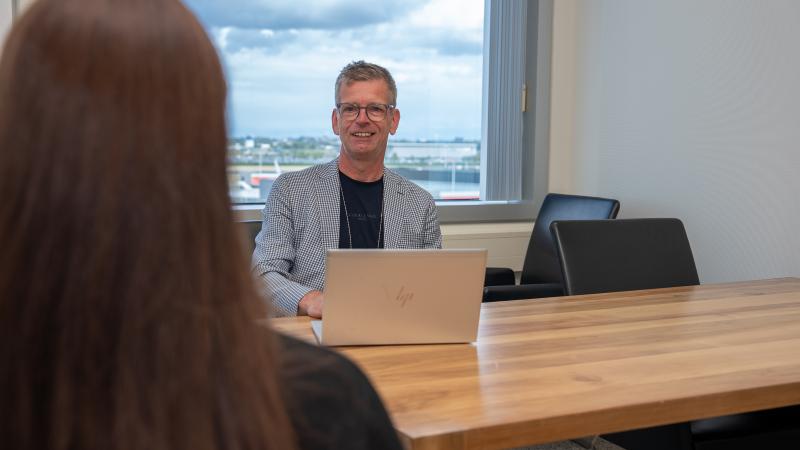
Colleagues are dedicated and work hard for the cause because they want to do their bit for the bigger picture.
Staff at the Border Office advise the Royal Netherlands Marechaussee and the Seaport Police on the entry of people into the Schengen area in the Netherlands: at Schiphol Airport, in Rotterdam and at Eindhoven Airport. The team also handles objection letters from people who have been refused entry, and takes part in training sessions organised by the Marechaussee and the police to explain the laws and regulations governing the Dutch border.
It is a perfectly ordinary morning when the phone rings at the Border Office. It is not the Marechaussee this time, but the Canadian liaison officer in the Netherlands, who is a migration expert at the embassy responsible for checking international flights and travel documents. A flight from Ethiopia has just landed at Schiphol Airport carrying a group of refugees on their way to Canada. During the flight, one of the women gave birth to her fifth child.
Both mother and baby are doing well, but the newborn is not allowed to fly because of the low cabin pressure. This has halted their journey to Canada. Also, the family only has a Canadian emergency travel document and no Dutch urgent visa. And the baby has no documents at all.
‘A number of questions arose all at once,’ says Herman. ‘How could the family legally enter the Netherlands? How could their visas be arranged? Where could they stay temporarily? And what place of birth do you register for a child born during a flight? There is no standard procedure for situations like this.’
Together with the Marechaussee, the COA (Central Agency for the Reception of Asylum Seekers) and the municipality of Haarlemmermeer, staff at the Border Office look for a solution within the framework of the law and regulations. The family is granted entry to the Netherlands on humanitarian grounds, and the necessary visas are issued on separate inserts. Just over a week later, the family is able to continue their journey to Canada.
Such cases are the exception rather than the rule. The bulk of the work at the Border Office consists of providing advice to the Marechaussee and the Seaport Police: can a person be refused entry, or not? Most of this advice is non-binding. However, sometimes the advice is binding, such as when it concerns minors or diplomats, or if a citizen of the European Union commits a crime at the border. In such cases, even the approval of the Director-General of the IND is required. Border Office staff have the mandate to do this.
‘If someone doesn’t have a passport, they don’t have a passport. It’s as simple as that,’ explains Herman. This is an example of clear grounds for refusing someone entry. ‘It becomes more difficult in borderline cases. Take, for example, someone who cannot provide a plausible reason for their intended journey, or the partner of an EU national who invokes the right to free movement within the European Union. If a situation falls into a grey area for border control, the matter is referred to us.’
Working at the Border Office requires a certain degree of flexibility. ‘Sometimes the nature of the work changes completely overnight,’ explains Herman. ‘Just think of the COVID-19 pandemic, when the EU imposed an entry ban. The Border Office set up a help desk at Schiphol Airport for travellers with questions about the new rules, which were changing every week. The Border Office also plays a key role in handling evacuations or repatriations, for example from the Middle East or Sudan. In such cases, you’ll be at Eindhoven Airport in the evening, working alongside KMar, the municipality of Eindhoven, the National Operational Crisis Centre and the Municipal Health Service (GGD), to facilitate arrivals and everything that entails.’
As well as carrying out advisory duties, Herman also trains members of the Marechaussee and the police force. For example, he explains how the laws and regulations governing the border process work and what is important when assessing a case. ‘The questions, comments and experiences they share can provide useful information for policymakers,’ explains Herman. ‘If the same point of confusion comes up repeatedly, we discuss it with legal advisers, policy officers and the Marechaussee.’
Herman is proud that these links have become stronger in recent years. ‘We have worked hard to bring together all the parties involved through an efficient consultation framework.’
Herman works in a small team that operates seven days a week. ‘Even in the evenings and at weekends, because office hours don’t apply to the border,’ he laughs. ‘You rely on each other more than when you work in a large team. It’s just like a relationship: you have to keep working at it together.’
He sees that same willingness outside his own team too. For example, colleagues from other departments also take their turn on the general on-call rota, alongside their regular work. Herman believes that this says a lot about the people who work at the IND. ‘Many colleagues are very dedicated and work hard for the cause. Not to earn a few extra euros, but because they want to do their bit for the bigger picture.’
It is partly thanks to that shared passion that Herman has been in his role here for years. But the career opportunities also keep him at the IND. ‘Here, you can get to know every aspect of the migration process. Fancy a change? Then there are plenty of opportunities, and you’re given the space to discover what suits you best. For example, we have our own IND Academy. I’ve changed roles several times in the past, and I’m still not bored here.’
Want to know more? Visit our Careers page and find the right vacancy for you!
‘Sometimes I issue a fine, but I prefer helping organisations find the right solution’ Tell your friends you work for the government and their reactions speak volumes: open-plan offices,…
‘There’s no standard procedure for some situations’ Should someone be allowed to enter the Netherlands or not? That is the question the Royal…
'The IND is not a rubber-stamping machine' For decades, asylum has been the subject of much debate, writing and discussion. Maninne wanted to…