The story of Kiran, legal representative
‘In court, I am the minister’s lawyer’ Kiran lived in an asylum seekers' centre in the Netherlands from the age of three until she…


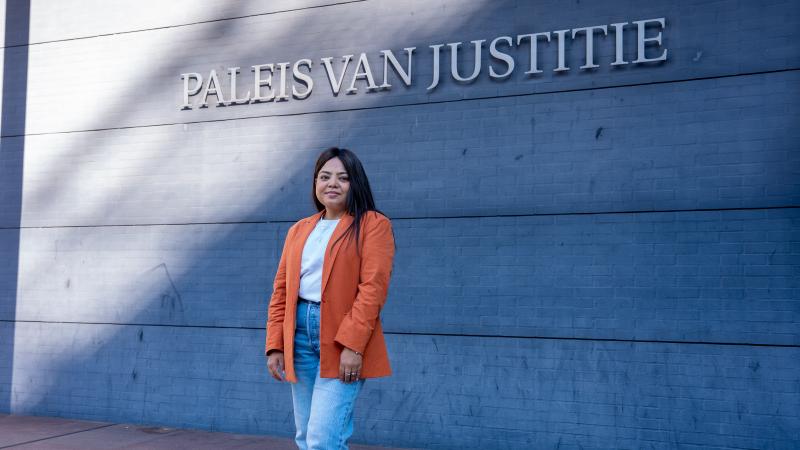
Don’t judge a book by its cover. We are all human.
An IND legal representative is a kind of lawyer for the Minister for Asylum and Migration. If an applicant disagrees with the IND’s decision on a residence application, they can appeal to the court. Kiran, or one of her colleagues, will then defend the IND’s decision in court or by submitting a written defence.
After Kiran and her family fled Afghanistan in 2000, they arrived in the Netherlands and had to wait for years. During that time, Kiran and her family always perceived the IND as a bogeyman. ‘When you grow up in an asylum seekers' centre, you hear a lot of negative stories about the IND,’ Kiran says. ‘But I always wondered: what would it be like to work there? Is it really as easy as people think?’
She knew from an early age that she would study law. ‘Even as a child, I told my parents: I’m going to become a judge, whatever it takes.’ Kiran laughs. ‘They never imagined I would end up in immigration law, though.’
‘They said: perhaps you can do things differently. Even if someone is not granted a residence permit, you can make them feel that you have taken their story seriously and that they are not just a number. I remind myself of that every time I enter the courtroom.’ Kiran’s parents are proud, although it was initially difficult for them when she decided to apply to the IND. ‘They remember their own procedure well, and not all those memories are fond ones.’
Kiran regularly finds herself in court, attending one hearing a week on average. ‘On such a day, I can have up to eight cases in a row,’ Kiran says. ‘The rest of the week, I prepare for hearings and draft written defences.’
Asylum cases require a keen mind, as the court looks at the situation on the date of the hearing, rather than at the time when the IND made its decision. ‘Even if something changed yesterday in the region someone comes from, it may affect the grounds on which an application was rejected. I am constantly checking if the position I am defending remains legally tenable. That makes the work very dynamic.’
The case that has stayed with her most concerned a girl in a refugee camp in a country she did not know. Her parents, brothers and sisters were already living in the Netherlands, having come here through the family reunification procedure, but the girl’s application was rejected. Because of her age, it was assumed that she was independent and no longer part of the family.
‘I had to defend that rejection in court,’ Kiran says. ‘While preparing the case, I saw that a new ruling by the Council of State might provide grounds for reconsideration. Age alone was not decisive, and more circumstances might be considered to determine if someone still belonged to the family. I thought: perhaps we should reassess this case. In the end, the girl was allowed to come to the Netherlands after all, to join her family.’
Legal representatives have the power to withdraw a decision and refer it back to the decision-making department. “It only ever happens in exceptional cases, though,” Kiran stresses. ‘I rarely withdraw a decision, but my perspective on a case file is different than the decision-making officer. Sometimes there are legal grounds for reassessing a case.’
Kiran has now worked at the IND for more than five years and praises the opportunities she is given to develop. For instance, she spent six months in a specialist team, advising colleagues on country policy in asylum cases, and, as a Legal Affairs ambassador, she represents the IND at careers fairs. ‘I really enjoy that. When I was a student, the IND had no internships and did not organise any guest lectures. You only knew the organisation from the news. Now students can come and see for themselves what it is like to work here.’
‘On my first day, I came in wearing a blouse and smart trousers,’ Kiran laughs. ‘But I was the only one. You wear whatever makes you feel comfortable. Jeans and an oversized jumper are perfectly fine. You only dress smartly for court.’
Thanks to the informal working atmosphere and warm ties between colleagues, Kiran feels completely at home. ‘I also felt it when I had to take time off last year because of a chronic condition. I wanted to get back to work quickly, but my manager urged me to take the time I needed, even though things were busy. That may sound obvious, but it made me feel safe.’
‘There is a lot of criticism of the IND in the media. Yet, what I see above all is how hard we work together and how welcome everyone is, whatever their background may be. So, I would like to say: do not judge a book by its cover. We are all just people, even at the IND.’
Want to know more? The IND recruits new legal representatives every month in The Hague, Zwolle and ’s-Hertogenbosch. Would you like to get acquainted? Come to the IND’s in-house day in The Hague on 13 November. Or visit our page on Working at the IND.
‘In court, I am the minister’s lawyer’ Kiran lived in an asylum seekers' centre in the Netherlands from the age of three until she…
‘Sometimes I issue a fine, but I prefer helping organisations find the right solution’ Tell your friends you work for the government and their reactions speak volumes: open-plan offices,…

‘There’s no standard procedure for some situations’ Should someone be allowed to enter the Netherlands or not? That is the question the Royal…