Het verhaal van Sijmen, call centre agent
‘A single conversation can change someone’s day, week, or even their life.’ Anyone who contacts the IND with questions about an application, a residence permit, or…


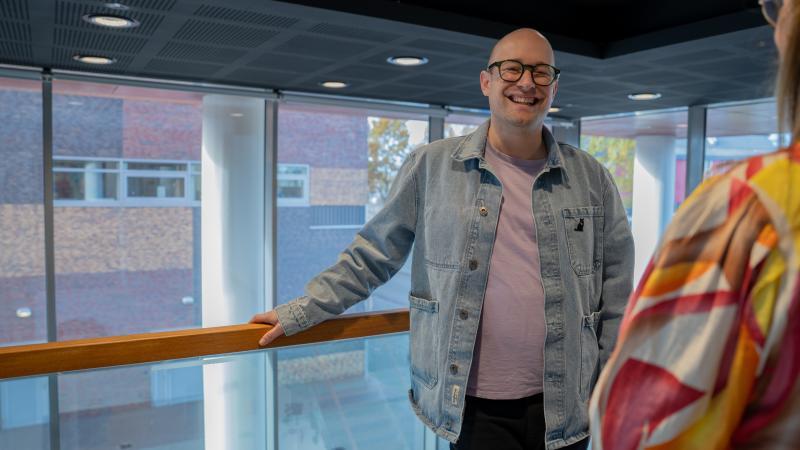
I speak to people from all over the world, from different backgrounds and cultures.
Public Information Centre staff are the eyes and ears of the organisation. They are in direct contact with people who need the IND and act as a bridge between them and the various departments within the organisation. They do this by phone, via chat, by email, and at the IND desk. Sijmen works in telephone support and assists callers every day.
‘Helping others is just part of who I am,’ Sijmen says with a smile. ‘I simply have a caring nature. Before I joined the IND, I worked in home care. But when that became too physically demanding, I looked for another way to put my strengths – listening, explaining, guiding people – to good use. I wanted to make a difference, for others and for society. When I came across the Public Information Centre, it turned out to be a great match.’
At exactly nine o’clock in the morning, the IND phone lines open. ‘But my day starts earlier than that,’ Sijmen explains. ‘I like to catch up with colleagues first, review relevant news, and prepare myself calmly for the first callers. At the moment I only man the phones, but people can also contact the IND by email or chat. The Public Information Centre is the first point of contact for all channels. We answer most questions ourselves, sometimes we refer people to other departments within the organisation.’
‘Most calls come from applicants, sponsors, or support workers,’ Sijmen continues. ‘Solicitors call as well, but they have a separate line with a different number. Conversations are always in Dutch or English. But an interpreter may listen in if the caller does not feel confident in either language. That can be a professional, but it is usually a relative or social worker.’
In a single morning, Sijmen may speak to people on five different continents. ‘People call us from all over the world,’ he says enthusiastically. ‘And they all have very different backgrounds and cultures. I learn a lot from talking to them, and it sometimes makes the work quite personal. Every caller communicates differently, so I constantly have to adjust and switch gears quickly. Not because the rules change, but because the person on the other end of the line is always different.’
Sijmen has had his fair share of memorable conversations, including one where emotions ran high at the other end of the line. ‘A Dutch man had been trying for two years to bring his wife and child to the Netherlands. But the person to whom he had entrusted submitting the application had done almost nothing all that time. I was able to explain what he needed to do to reunite his family. By the end of the call, he was crying tears of relief. It's a conversation I will never forget.’
‘And there are many more examples like it,’ Sijmen continues. ‘The Public Information Centre answers questions about almost every type of residence permit, from naturalisation to study, and from family reunification to work. Once, for example, someone called to ask why King Willem Alexander had signed their letter. I explained that naturalisation is formally a royal decision, and can still remember the caller's amazement.’
But Sijmen knows all too well that conversations can also be tough. ‘A single conversation can change someone’s day, week, or life. Sometimes, callers do not get the answer they wanted. It is my job to explain that clearly and, where appropriate, refer them to another organisation. I have also had callers who expressed suicidal thoughts or spoke about domestic violence. In situations like that, I do not hang up until the caller knows where they can turn for help beyond the IND.’
After difficult conversations, Sijmen can always turn to his manager or colleagues. ‘You step away from the phones for a moment and talk it through,’ he says. ‘I really appreciate the atmosphere at the IND: they treat you like a human being. That should be the case with every employer, but unfortunately I have experienced otherwise. That is why I value the sense of safety and space I feel here so much. There is genuine attention for both your personal and professional development.’
‘What others should know about my work at the IND? That we are truly committed to people and society,’ Sijmen concludes. ‘Every question or situation receives the personal attention it deserves, and we work with care and diligence. Therefore, things can take a bit longer from time to time, but at least we are fair. And that is something I am proud of.’
‘A single conversation can change someone’s day, week, or even their life.’ Anyone who contacts the IND with questions about an application, a residence permit, or…
‘Ik vertaal wensen naar werkende oplossingen’ Marco stapte als ‘externe’ bij de IND binnen, maar wist al snel dat dit een plek was waar hij wilde…
'Warm contact maakt moeilijk werk menselijk' Frank loopt al 25 jaar rond bij de Immigratie- en Naturalisatiedienst (IND). Hij noemt zichzelf een…