The story of Murelle, Intervention Team coordinator
‘We deal with any nuisance as quickly as possible’ No other topic stirs up as much emotion as migration – from big newspapers headlines to kitchen…

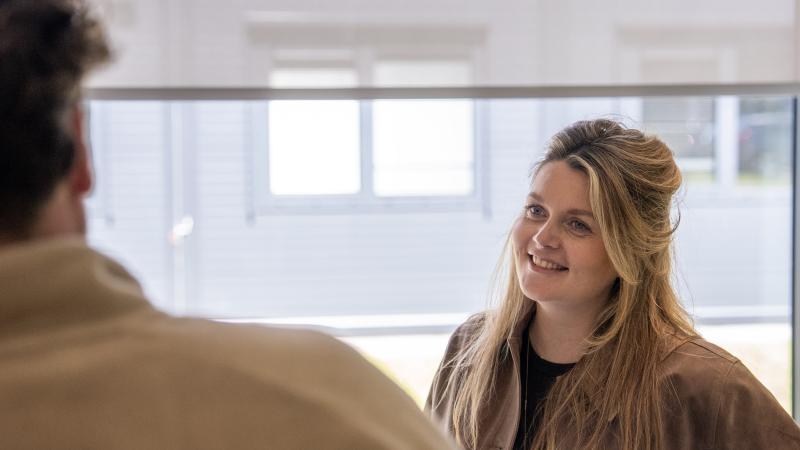
‘It’s a small group that’s spoiling things for everyone else, and we’re doing our best to address that.’
The Intervention Team is a multidisciplinary unit in which the IND, the COA and the Repatriation and Departure Service (DT&V) work together to deal with asylum seekers who cause a nuisance. This can be done, for instance, by applying an accelerated asylum procedure. The Intervention Team works mainly at the Ter Apel application centre. On behalf of the IND, Murelle coordinates cooperation between the partners in the chain and assesses if nuisance reports can be dealt with more quickly.
These reports come from various sources, including COA staff, the police and IND employees. They can be about aggressive behaviour, intimidation or vandalism near a reception centre. ‘The Intervention Team assesses these reports,’ Murelle explains. ‘Who are they about? How likely is it that this person will be granted a residence permit in the Netherlands? If we see reasons to prioritise their application, we will fast-track it in the accelerated asylum procedure. In some cases, that means that the person’s asylum application is rejected within a week.’
The entire asylum chain works together to facilitate these accelerated procedures. ‘We discuss these cases in our chain partner meetings. We also deliver the rejection together with DT&V, so that the first exit interview can begin straight away. By doing that, we try to minimise the amount of time people spend in our reception centres. That benefits everyone: us, our chain partners, and of course the other residents of the asylum seekers’ centres.’
Murelle emphasises that disruptive behaviour never leads to a quicker positive decision. ‘If someone is likely to be granted asylum, we don’t fast-track their application. We don’t want to reward people for causing problems. But elsewhere in the chain, our partners will try to look for ways to put a stop to the nuisance.’
The Intervention Team is a relatively new addition to the asylum chain. Murelle was involved right from the start, when the working method was being developed. ‘My colleague and I established this procedure together with our chain partners,’ she says. ‘That has left us with plenty of scope to keep developing and improving things.’
Much of her work revolves around this development. ‘I’m involved in political projects, such as setting up the process availability site. That’s a sort of basic accommodation for asylum seekers who cause trouble and are likely to have their applications rejected. The Ministry has drawn up a sector-wide set of working instructions, and it’s up to me and my colleagues to implement these in practice. We also have to reach working arrangements with the COA, DT&V and AVIM. I’m a key link in the chain and get to go to places you wouldn’t normally visit as an IND employee, such as police stations and town halls. We’ve also taken part in several joint operations at the Utrecht Central railway station, and we’ve been on night shift ride-alongs with the Amsterdam police.’
Murelle enjoys the variety that her work offers her. ‘I do need a bit of action, otherwise I get bored really quickly,’ she jokes. ‘I thrive on that dynamic energy. Thinking on your feet, the hustle and bustle, being at the centre of the chain – I love it all.’
Still, some aspects of her work can be challenging. People tend to overlook just how small the group that causes problems actually is, she says. ‘It’s a sensitive subject and everyone has an opinion on it,’ she says. ‘Some people paint a picture in which the vast majority of asylum seekers cause trouble. That’s not the case. It’s a small group that’s spoiling things for everyone else, and we’re doing our best to address that.’
‘Of course, we also see behaviour that clearly crosses the line. But it’s important that we stay objective, and that we don’t lose sight of the person behind the behaviour,’ she adds. ‘Someone might display disruptive behaviour because of medical problems or mental health issues. Where possible, we tailor our approach to meet these people where they’re at. Whatever the situation may be, someone who has caused a disturbance is still entitled to a fair assessment of their application. Their behaviour doesn’t affect that.’
What makes her work so rewarding? ‘I really feel there is a societal need to do something about this issue,’ says Murelle. ‘And the great thing is that I’m actually able to get things done, precisely because the chain works so well together. If an action plan is successful, we feel that we’ve done something useful – for the organisation, but also for the people in the reception centre. We improve their safety. I’m doing my bit to make the Netherlands safer.’
Even after twelve years, her work can still surprise her. ‘I started out as an interview staff member at a time when a lot of asylum seekers from Eritrea were arriving in the Netherlands. Thanks to their stories, I still know Asmara – the capital of Eritrea – like the back of my hand,’ she laughs. ‘That’s what I like the most about working at the IND: you get to meet people from all over the world. Everyone has their own story, their own language and culture. It’s not the sort of job where you can just switch to autopilot, because everything that happens in the world affects our work. But that’s exactly what I love about it.’
Do you want to know more about how the IND deals with asylum seekers who cause a nuisance? Read the background article How the IND prevents nuisance from asylum seekers and the article Overlastgevers komen er niet mee weg (only available in Dutch) in the magazine Mens en Migratie (formerly VreemdelingenVisie).
‘We deal with any nuisance as quickly as possible’ No other topic stirs up as much emotion as migration – from big newspapers headlines to kitchen…
‘I get to the bottom of cases here’ What is it like to do an internship at the IND? Lisa calls it a great learning experience and is…
'I'm right at the heart of the organisation' After a long meeting, Annelies usually goes back to her laptop. As the dust settles from all the…