The story of Mohamed, Enforcement and Monitoring Officer
‘Sometimes I issue a fine, but I prefer helping organisations find the right solution’ Tell your friends you work for the government and their reactions speak volumes: open-plan offices,…

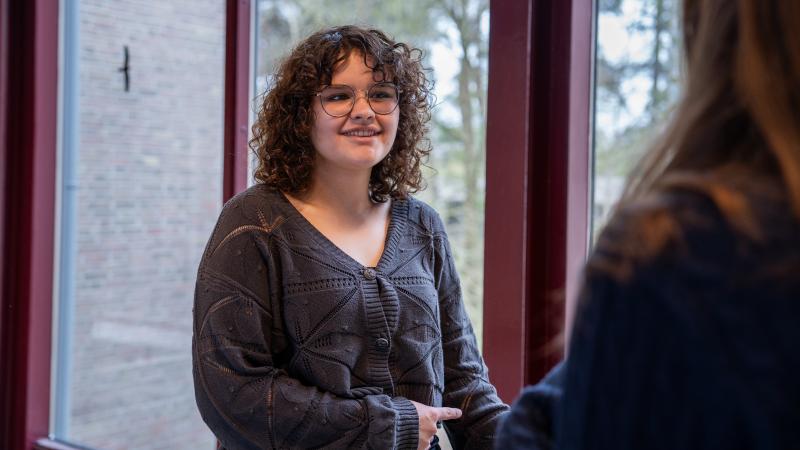
Every case feels like a puzzle that you have to put together carefully.
For her internship, Lisa is spending about eight months at the IND asylum department in Budel. She independently analyses stories of applicants, after which she writes a ‘minute’: an internal document setting out her analysis and recommended decision. Once this has been approved by a senior colleague, Lisa writes an official decision. This is then signed by her internship supervisor, who is ultimately responsible, after which the case is closed.
Before Lisa started at the IND, she was on the other side of the process. As an intern at the Dutch Council for Refugees in Eindhoven, she helped people with family reunification applications. ‘I saw the waiting times, the frustration, the uncertainty. And I wondered: why is this taking so long? What’s happening on the other side? I was curious about that. So, when I came across the vacancy in Budel, I didn’t have to think twice.’
Working for the IND has given her a broader view of the migration process. ‘Obviously, there’s the large number of applications, but the work is also incredibly complex. And you don’t notice that until you’re in the middle of it. I understand much better now why things can’t always go as fast as people want.’
As an intern, Lisa mostly deals with asylum applicants from Eritrea, but she also works on cases involving Ahmadiyya Muslims from Pakistan. These require different review and decision-making approaches. ‘With applicants from Eritrea, it’s often about the risk of serious harm upon return. In Ahmadiyya cases, religion is the ground for protection. So, it’s a very different way of looking at a file.’
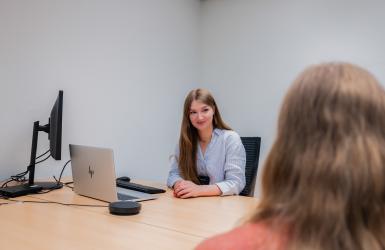
‘Every case feels like a puzzle that you have to put together carefully,’ Lisa continues. ‘You get all these separate bits of information: statements, documents, country of origin information and legal frameworks. And then it’s up to you to turn those into a complete picture that makes sense. Doing that research is very interesting to me. I really have to dive into the substance of these cases to get to the bottom of them, and to see how everything is connected. It’s not always easy, but I love the challenge of it.’
That challenge might be what Lisa enjoys most about her internship. ‘It’s an area of law that my degree programme doesn’t cover at all,’ she says. ‘So, everything is new. The complexity stems not only from the laws and regulations, but also has to do with the review process itself. You have to consider each file carefully, decide what’s plausible and keep in mind the applicant’s personal situation. So, there’s also a real human side to this work. You try to put yourself in someone else’s shoes, and you work with the person’s own frame of reference. That’s not something you learn in school – that your own assessment makes such a huge difference.’
One case that stood out to her had to do with the discrimination and stigmatisation of people with HIV in Eritrea, an issue that affects women in particular. Little was known about how the government intended to handle this. ‘That made it a very interesting case for me, so I used additional country information to understand the situation,’ Lisa says. ‘The woman involved had a traumatic past. She’d been abused and was receiving psychological treatment in the Netherlands. For me, it felt extra special to write that decision and give her clarity and peace of mind. Moments like that make you realise how meaningful this work is.’
Lisa really enjoys working with her team. ‘Everyone is very helpful, and I have a lot of contact with other interns and experienced interview and decision-making staff members. We all have different areas of expertise, and we regularly meet up to share our knowledge.’
Looking back on her internship at the IND so far, she calls it a rewarding experience. Not least because she was given a great deal of independence and responsibility. ‘I’m not one of those interns who just hangs around,’ she says, laughing. ‘I really contribute. Of course there’s guidance, but that’s mainly to help me move forward in a role that I perform independently as much as possible. That’s what makes this internship such an intensive and incredible learning experience. The past few months have been quite challenging, and I can tell that the work I do here really matters.’
If you are looking for an internship, check out our internship page. If you ask Lisa, it’s a no-brainer. ‘If you want to learn by doing and discover something new, this is the place to be. It’s not easy, but that’s exactly what makes it so rewarding. I want to continue growing at the IND after my graduation, so I hope this internship is just the start.’
‘Sometimes I issue a fine, but I prefer helping organisations find the right solution’ Tell your friends you work for the government and their reactions speak volumes: open-plan offices,…
‘There’s no standard procedure for some situations’ Should someone be allowed to enter the Netherlands or not? That is the question the Royal…
'The IND is not a rubber-stamping machine' For decades, asylum has been the subject of much debate, writing and discussion. Maninne wanted to…