Why are asylum seekers waiting longer and longer for the IND to decide?
In 2022, asylum seekers had to wait an average of 31 weeks for a decision from the IND on their asylum applications. By 2025 this period had increased to an average of 67 weeks, and the expectation is that it will increase even further in 2026. Asylum seekers in the Netherlands are waiting for a decision on their future for far too long and for increasingly longer periods. The question is why that is the case and what is the IND doing about it?
For years now the IND has been unable to process all asylum applications by the statutory 6-month deadline. People have had to wait for a decision for longer and longer since 2021.
More asylum applications than the IND can cope with
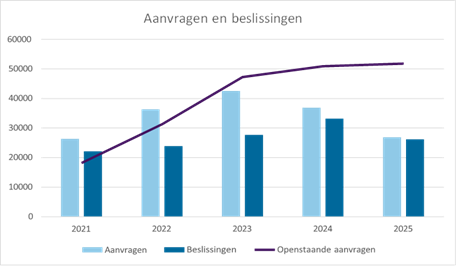
A major cause of the increasing waiting times is the marked rise in the number of asylum applications. More people are applying for asylum than the IND can keep up with. This was particularly true in 2022 and 2023 and the number of pending applications has continued to rise since. This is reflected in the graph below.
Applications, decisions, and pending applications in the context of the general and extended asylum procedures
The IND has been expanding its workforce considerably since 2020. Despite that, the organisation has been unable to cope with the increase in the number of applications. This is because new employees first need to complete internal training and an onboarding programme before they can become fully operational. That is why the IND is arguing that it should receive stable funding over a number of years, with a focus on the longer term. It should not be the case that the IND has to cut back on staff whenever there is a temporary decline in the number of people applying for asylum. This approach would ensure that enough trained staff are available if the number of applications starts increasing again. Although stable, long-term funding would be helpful and is anticipated, no commitment has yet been made. In recent years, the IND has done everything in its power to process as many applications as possible, but its efforts have still fallen short.
The asylum decision making process has become more complicated
Another reason why asylum seekers are having to wait longer is because the decision-making process is becoming increasingly complicated. This is a result of to changes in policy and implementation, as well as court rulings. The IND has been assigned more tasks and is having to consider more and more information. The result is that the internal work instructions have become increasingly lengthy and complex, while employees are, on average, less experienced. This was the conclusion of research IND did in 2024, on processing asylum applications in 2010-2022.
Waiting times affected by political decisions
Political decisions also affect waiting times. For example, the IND has been instructed to speed up the processing of applications which are likely to be rejected, or which have been filed by problematic asylum seekers, or process a minimum number of Syrian cases each week. This has led to an increase in waiting times for other asylum applications.
The European Pact on Migration and Asylum is helping to shorten waiting times
The IND has long maintained that the current asylum system is no longer sustainable. The procedure has become too complex, involves too many steps, and lacks flexibility. Hiring more staff is not the solution and numerous studies have shown that more is needed than that to make accurate and prompt decisions on asylum applications and reduce waiting times. The introduction of the European Pact on Migration and Asylum on 12 June 2026 is helpful because it gives European Member States the opportunity to make their asylum processes shorter and more flexible. Since it was introduced, the IND has been working with a new procedure which it will keep perfecting in the time ahead.
New asylum procedure makes it possible to keep up with applications since the Pact on Migration and Asylum came into force
The IND is required to process applications received on or after 12 June 2026, which is the effective date of the Pact on Migration and Asylum, within 6 months, or within 3 months under the accelerated procedure. It has been impossible to meet the Pact’s short deadlines using the existing asylum procedure, which involves so many intermediate steps. However, the new asylum procedure, which eliminates several steps, does make it feasible, as long as the IND treats these applications as a priority. This change will prevent many pending applications from accumulating alongside those submitted after June 12.
Action plan for applications filed before the Pact on Asylum and Migration
The new, shorter and more flexible asylum procedure could also be used for the 50,000 or so asylum applications which the IND still had to process as of 12 June 2026, which was the effective date of the Pact on Asylum and Migration. However, the focus on the applications dating from after 12 June means it would take an unreasonably long time to process the applications submitted before this date. That cannot be allowed to happen from the perspective of the applicants, as well as, for example, the Central Agency for the Reception of Asylum Seekers (Centraal Orgaan opvang asielzoekers, COA) and the municipalities that are responsible for providing asylum support. Additional measures are therefore needed and an ‘action plan for pending asylum applications submitted before 12 June 2026’ (only available in Dutch) has now been drawn up to deal with these applications.
Categorisation for faster processing
The Minister of Asylum and Migration has instructed the IND to decide on all applications submitted before 12 June 2026 within three years of that date. This instruction was included in a letter (only available in Dutch) which the minister sent to the House of Representatives and which forms the basis for the measures outlined in the action plan. Applications are to be divided into four categories (A, B, C, and D) based on rejection and approval rates, country policy and complexity. This classification system allows, to some extent, for a standardised approach. Examples of other measures which are designed to help achieve the objective include setting up a preliminary phase to complete the application, adopting a risk-based approach, and asking more targeted questions during interviews.
The IND publishes monthly updates about the processing progress of asylum applications received before and after 12 June 2026.
Some people who apply for asylum may need additional support, for example if they are an unaccompanied minor, have experienced trauma, are pregnant, or have mobility or other health issues. Although the need for additional support might be…
Each year, the Dutch Immigration and Naturalisation Service (IND) processes tens of thousands of applications from people who want to stay in the Netherlands. For some time, the IND has been receiving more applications than it can process, meaning…
Where an asylum seeker comes from is one of the key questions in the assessment of an asylum application. The security situation in someone’s country or region of origin will often determine whether they qualify for a residence permit. If there is…