Residence document Model 2020
To stay in the Netherlands for a longer period of time, a valid residence document model 2012 or model 2020 is required. Find out more about residence document model 2020: What information it contains, which types of foreign national documents there are and how to know whether a document is genuine.
Information on residence document (model 2020)
Types of residence documents (model 2020)
Model 2020 has the following types of residence documents:
This is for persons who are allowed to reside in the Netherlands temporarily on ordinary grounds.
Purpose of residence
The purpose of residence is indicated on the back of the document under the heading ‘comments’. This is the reason for residence in the Netherlands. For example, residence with family or relatives, study or paid employment.
Employment rights
It is also indicated under the heading ‘comments’ whether the person is allowed to work in the Netherlands and whether a work permit (in Dutch: tewerkstellingsvergunning or TWV) is required. This depends on the purpose of residence.
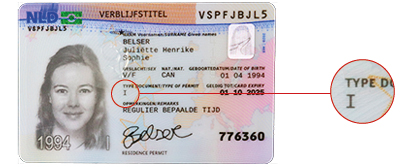
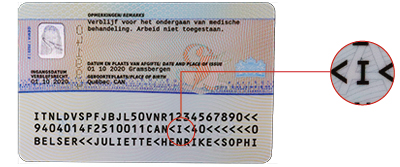
This is a permit for persons who are allowed to reside permanently in the Netherlands on ordinary grounds.
Employment rights
Persons with this permit are allowed to work in the Netherlands without restrictions. This means that no work permit (in Dutch: tewerkstellingsvergunning or TWV) is required.
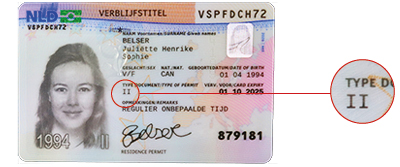

This is a permit for persons who have been granted temporary asylum in the Netherlands.
Employment rights
Persons with this permit are allowed to work in the Netherlands without restrictions. This means that no work permit (in Dutch: tewerkstellingsvergunning or TWV) is required.


This is a permit for persons who have been granted permanent asylum in the Netherlands. They have already had a temporary asylum residence permit for at least 5 years and still need protection in the Netherlands.
Employment rights
Persons with this permit are allowed to work in the Netherlands without restrictions. This means that no work permit (in Dutch: tewerkstellingsvergunning or TWV) is required.
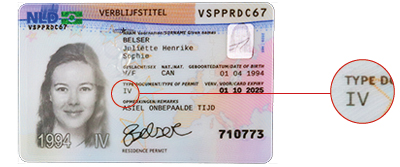
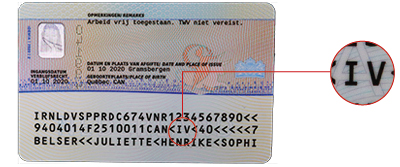
This is a permit for persons who are allowed to reside permanently in the Netherlands, and have 'long-term EU resident' status.
Employment rights
Persons with this permit are allowed to work in the Netherlands without restrictions. This means that no work permit (in Dutch: tewerkstellingsvergunning or TWV) is required.
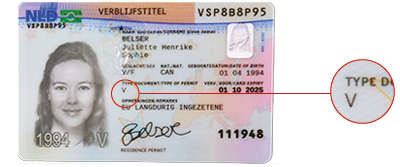
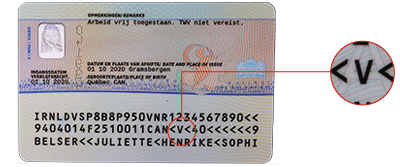
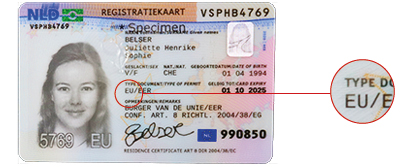
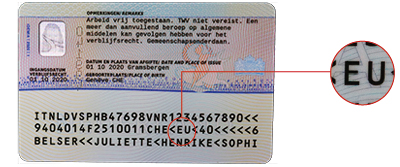
This is a document for persons with the nationality of a country that is a Member State of the European Union (EU), a member of the European Economic Area (EEA) or Switzerland. The following 2 types of proof of a right of residence exist for these persons:
- The registration card “Burger van de Unie/EEA” for citizens of the EU,EEA or Switzerland who have been in the Netherlands lawfully for 5 or more consecutive years. And meet the criteria of Article 19 of the Directive 2004/38/EG.
- The registration card “Burger van de Unie/EEA” for citizens of the EU/EEA or Switzerland who have been in the Netherlands lawfully for fewer than 5 years. And meet the criteria of Article 8 of the Directive 2004/38/EG.
Employment rights
Persons with a registration card “Burger van de Unie/EEA” are allowed to work in the Netherlands without restrictions. This means that no work permit (in Dutch: tewerkstellingsvergunning or TWV) is required.
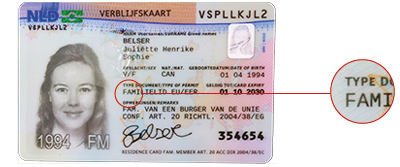
This is a document for family members of a Community national. The family member does not personally have the nationality of a country that is a Member State of the European Union (EU), member of the European Economic Area (EEAR) or Switzerland. The following 2 types of residence permits exist for these persons:
- The residence card for family members who have been in the Netherlands lawfully for 5 or more consecutive years. And meet the criteria of Article 20 of the Directive 2004/38/EG.
- The residence card for family members who have been in the Netherlands lawfully for fewer than 5 years. And meet the criteria of Article 10 of the Directive 2004/38/EG.
Employments right
Persons with these documents are allowed to work in the Netherlands without restrictions. This means that no work permit (in Dutch: tewerkstellingsvergunning or TWV) is required.
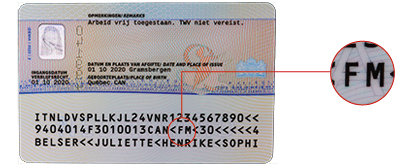
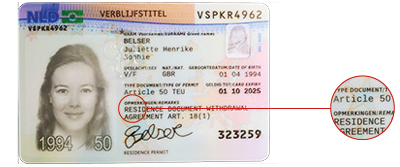
This is a document for persons who have the nationality of the United Kingdom, and for their family members. The following 2 types of residence documents exist for these persons:
- The document ‘Permanent Residence Document Withdrawal Agreement 18(1)’. This document is for persons who have been in the Netherlands lawfully for 5 or more consecutive years and meet the criteria of Article 15(1) and Article 18(1)(i) of the Withdrawal Agreement.
- The document ‘Residence Document Withdrawal Agreement 18(1)’. This document is for persons who have been in the Netherlands lawfully for fewer than 5 years and meet the criteria of Article 13(1) and Article 18(1)(i) of the Withdrawal Agreement.
Employment rights
Persons with these documents are allowed to work in the Netherlands without restrictions. This means that no work permit (in Dutch: tewerkstellingsvergunning or TWV) is required.
1.
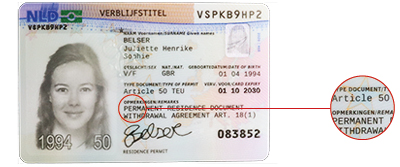

2.
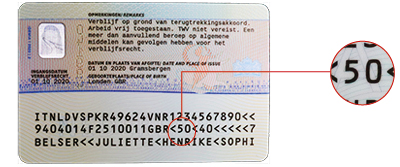
This is a document for persons who have the nationality of the United Kingdom and their family members. These persons fall under the Withdrawal Agreement and are registered as frontier workers in the Netherlands.
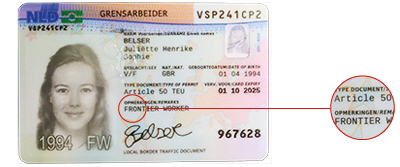
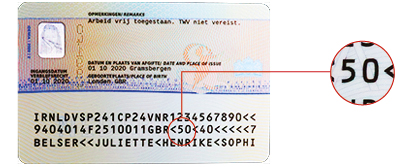
Examples of foreign nationals documents
The videos on this page are visual examples. The videos do not include more information.
Authenticity features on residence document (model 2020)
There are fine line structures and patterns throughout the document. You can see this using a magnifying glass.
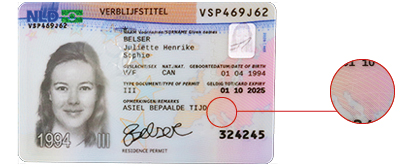
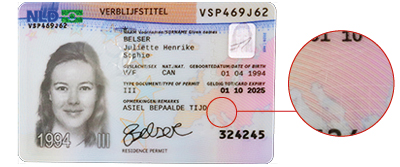
On the front and back of the document you will find the repeating micro text "NLD" and "koninkrijk der Nederlanden". You can see this text with a magnifying glass.
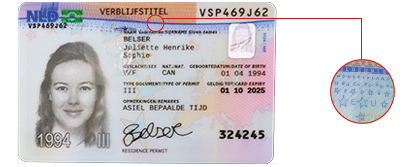
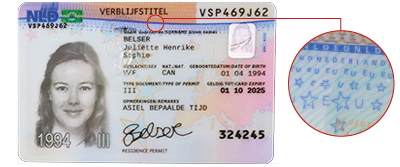
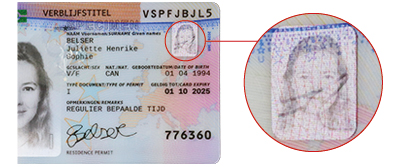
The top right of the document includes a passport photo window. If you hold the window up to the light, a passport photo will appear.